

What is Bill of Lading? Know the Types and Functions
Sourav Banik
Author

- A bill of lading is a legal document that acts as a receipt, contract, and proof of ownership for shipped goods.
- This bill allows transfer of ownership while goods are still in transit.
- Banks, insurers, and customs authorities rely on the bill of lading for payments, claims, and clearance.
- Cargo shipments can get delayed and cancelled without proper bill of lading.
- A bill of lading is different from a shipping bill as a shipment bill is used for customs approval.
- Exporters must always verify details on the bill of lading to avoid legal, financial, and operational problems.
What is Bill of Lading?
If you’re into a global export import business, a bill of lading is a crucial document for you. In simple terms, a bill of lading meaning is a legally binding document issued by a carrier to a shipper, which contains details about the carrier, shipment, the consignment goods and more.
The bill of lading meaning is a contractual relationship between the exporter and the shipping business. You can think of this bill as an acknowledgement receipt for shipping the goods to the shipper. For example, if your cargo leaves Mumbai Port destined for New York, you need to have the original bill of lading to know the details of the shipment, and also prove that you have dispatched the goods.
Also read what is a fumigation certificate for export of goods.
Functions of Bill of Lading
There are mainly four basic functions which is why businesses require different types of bill of lading.
Trade Receipt
As soon as your marine cargo leaves for the port, the bill of lading becomes the only written proof that shows details of the shipment. It acts as a receipt confirming that the carrier has received the goods from the shipper in the specified condition and quantity. Both the parties, the exporting business and the carrier cannot dispute or frame legal liabilities against each other because of the bill of lading.
Legal Proof
Second, the bill of lading serves as conclusive evidence of the contract of carriage between the shipper and carrier. If you examine this bill, you will find details such as the terms of goods exchange and shipping liabilities. In case of any missing cargo, you can present this bill of lading to avoid a legal claim. However, the best way to protect your business from such claims is to insure your cargo, which protects against accidental collision, legal claims and theft.
Legal Title
Thirdly, the bill of lading functions as a document of title. This means the business entity holding the bill of lading has legal ownership rights over the cargo. This business by law can purchase, sell, or transfer their cargo during transit.
Transferability
A cargo after leaving for shipment, is not necessarily sold between two parties. For example, it can leave Chennai port to enter Felixstowe port in the United Kingdom, and then again get sold to another trader in Dublin port. A bill of lading allows the right or cargo to be endorsed and transferred to different traders.
Also read the top 5 roads to avoid a cargo accident in Pune.
What Information Bill of Lading Contains?
Bill of lading meaning is a document that contains crucial information about the shipping details, name of carrier and the cargo. Check this below bill of lading sample:
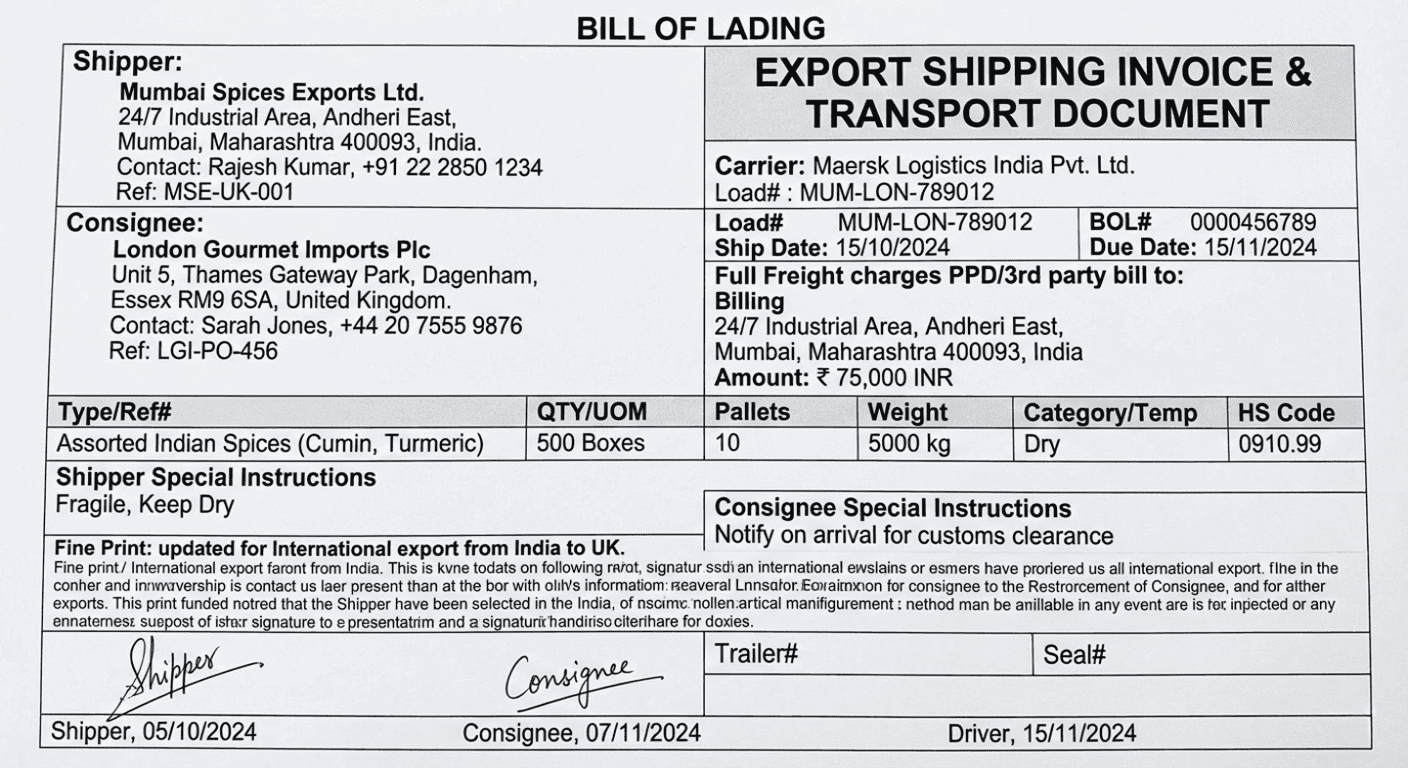
The bill of lading contains information about:
- Shipping company name and address
- Carrier name and address
- Purchase order number
- Cargo description
- Date of dispatch of cargo
- Gross/net weight
- Port of cargo loading and dispatch
- Special note for reference
Who is Involved in Bill of Lading?
There are multiple entities that play a vital role in possessing and utilizing the bill of lading.
Shipper / Exporter
The shipper (also called the exporter) is the legal owner of the cargo who prepares the original bill of lading. They are in charge of drafting the accurate cargo details to the carrier, and ensuring the cargo conditions meet the IMDG and ATPCO standards.
Carrier
The carrier is the transportation company that transports the goods from origin to destination. The carrier issues the bill of lading upon receiving the cargo and assumes responsibility for delivering it safely to the designated destination.
Consignee
The consignee is the party designated to receive the goods at the destination. This can be either the warehouse operator or the actual purchasing business. In some cases, a consignee can be a freight forwarder or agent for the buyer.
Notify party and intermediaries
The notify party is the person or the business that should be informed when the shipment arrives at the destination port. The consignee themselves often act as the notify party, or it can be the customs broker or the freight forwarder.
Who Issues Bill of Lading?
The bill of lading is usually by the carrier to the shipper. However, in some circumstances, it can also be issued by freight forwarders, NVOCCs and sometimes by port agents. But what does it mean to issue a bill of lading?
What Is Meant by Issuing Bill of Lading?
A bill of lading is issued only when the marine cargo has been dispatched from the shipping company to the carrier. Unless the cargo has been handed over to the carrier and loaded inside the carrier ship, a bill of lading cannot be issued. The primary issuer is the carrier, which is a company that physically transports the cargo. This carrier can be a shipping line for ocean freight, or an airline for air cargo, or a trucking company. The issuer changes if the carrier transfers, for example, if the carrier is the freight forwarder, they will issue a house bill of lading on behalf of the shipper.
Also read the difference between demurrage and detention of cargo.
Importance Bill of Lading
Let’s understand the importance of the bill of lading with an example first. In 2023, a textile exporter from India faced a three-week delay and got their consignment cancelled at the Port of Singapore. The reason for this was the bill of lading was not properly prepared. Most banking institutions do not release or credit funds without a proper bill of lading.
If you have marine cargo insurance, a bill of lading is important there too, as insurers need the bill to process the claim. Moreover, in case of legal disputes, the bill of lading can work as a great tool to resolve such disputes. It’s a written record of the details of the goods shipped, and admissible into court of law as an evidence of the consignment.
Objectives of a Bill of Lading
A bill of lading serves multiple objectives for both the shipping party and the carrier. Below are some of the objectives:
Evidence of Contract
The original bill of lading stands as legally binding evidence of the contract of carriage between the shipper and carrier. This contractual evidence becomes invaluable when disputes arise about delivery timelines and any party decides to claim damage. Having marine cargo insurance can be more beneficial in this too, as it covers any cases of delay in shipment or damage of cargo.
Receipt of Goods
The bill of lading also acts as a receipt and facilitates the accounting practice of both the parties. While auditing a firm’s books of accounts, auditors may ask for the bill of lading to understand the amount and any discrepancy during global trade. This receipt function protects exporters by providing proof that they fulfilled their obligation to deliver goods to the carrier.
Document of Title
The bill of lading confers ownership rights over the cargo to whoever possesses it. Once a party has the bill of lading, they are the legal owner of the cargo. This characteristic enables goods to be bought and sold while they're still in transit. Banks accept bills of lading as security when providing trade finance, knowing they can claim the goods if the borrower defaults.
Customs Clearance
A bill of lading meaning is a document that shows the legal trade of cargo with shipment details. At custom offices, not having a bill of lading may actually pause the clearance process. The reason for having the bill of lading is it provides essential information for calculating duties and verifying compliance with import-export regulations.
Insurance Claims
If your cargo suffers damage during transit or faces theft, your marine insurer demands the bill of lading as primary evidence. The document shows the details of shipment and date of shipment, which your insurer uses to overwrite and calculate the claim to be processed.
How Bill of Lading Works
The Bill of Lading is Prepared
As the first step, the bill of lading, the carrier inspects the cargo to verify quantity, packaging condition, and basic description. If the carrier is satisfied, they start to draft the bill of lading based on the cargo information.
Claiming the Cargo
After the cargo is loaded onto the vessel, truck, or aircraft, the carrier releases the bill of lading to the shipper. The shipper then forwards this document, along with other required papers, to their bank if payment is through a letter of credit. The bank verifies the documents and transmits them to the buyer's bank, which releases them to the buyer upon payment or acceptance of the terms. The buyer then presents the bill of lading to the carrier's agent at the destination to claim the goods.
Types of Bills of Lading explained with use cases
Straight Bill of Lading
A straight bill of lading is a non-negotiable document that specifies that the cargo has been assigned to a particular entity, and such a bill cannot be negotiated.
Order Bill of Lading
An order bill of lading is drafted "to order" or "to the order of" a specific party, usually a bank. When the cargo is transferred multiple times during transit through endorsement, the order bill of lading is issued.
Bearer Bill of Lading
A bearer bill of lading is more simple, it states that the cargo has to be delivered to any entity who physically has the bill. It is one of the highly negotiable types of bill of lading and can be transferred simply by handing over the document without any endorsement.
Clean Bill of Lading
A clean bill of lading indicates that the carrier received the goods in apparent good condition with no visible damage, defects, or packaging issues noted. In India, banks typically demand a clean bill of lading for letter of credit transactions because they provide assurance that the cargo is shipped in better condition.
Claused Bill of Lading
This type of bill of lading is issued whenever there is a defect or damages, or discrepancies discovered in the good. Claused bills are usually not accepted by banks because they indicate that the cargo has been damaged during shipment.
House Bill of Lading
A house bill of lading is issued by the Ocean Transport Intermediary freight forwarder or NVOCC. This document is the receipt that the cargo has bene shipped to the carrier, and is an evidentiary document of the contract.
Master Bill of Lading
A master bill of lading is a transfer receipt, drafted by the carriers to the freight forwarder or NVOCC. Individual exporters whose cargo is consolidated under a master bill of lading receive their own house bill of lading from the freight forwarder.
Ocean Bill of Lading
An ocean bill of lading is specifically used for sea freight transportation. It includes specific maritime terms, references to international shipping conventions, and clauses related to perils of the sea.
Inland Bill of Lading
This is one of the types of bill of lading that covers domestic or regional transportation by land, typically by truck or rail. For example, the cargo that is shifting from Pune to Mumbai port, will be having an inland bill of lading.
Multimodal Bill of Lading
A multimodal bill of lading, also called a combined transport document, involves two different modes of transport. It is usually a land or an ocean on which a multimodal bill of lading depends on, and the freight mode even can vary.
Shipped Bill of Lading
A shipped bill of lading confirms that goods have actually been loaded onto the specific vessel and the cargo has left the port of origin. You can find the “shipped on board” notation with the date of loading.
Received Bill of Lading
Before the cargo is loaded into the vessel, the carrier takes custody. This sometimes creates confusion among the carrier, which is why a bill of lading is issued.
Charter Party Bill of Lading
A charter party bill of lading is an agreement between the charterer and the owner of the vessel. This bill is usually issued for bulk commodities such as grain, coal, or iron ore.
Surrender Bill of Lading
A surrender bill of lading occurs when the original bill of lading is surrendered at the port of origin, allowing the consignee to receive the goods at destination without presenting the physical original document. This is useful for short sea routes where the vessel might arrive before the physical bill of lading can reach the consignee.
Also read the difference between top up and super top up health insurance.
Shipping bill vs bill of lading
As an exporter, you must understand the major differences between shipping bill vs bill of lading. While a shipping bill is a legal document authorized by the Indian government for customs clearance, a bill of lading is simply an acknowledgment receipt issued by the carrier. Here are the main differences explained below:
| Bill of Lading | Shipping Bill | |
|---|---|---|
| Meaning | Legal document used to show details of shipment | Legal document used to obtain custom clearance |
| Objective | Acknowledgment receipt for shipment | Document for customs clearance and obtain export permission |
| Transferability and cargo ownership | Bill of lading shows the legal owner of cargo and can be transferred | Shipping bill does not show owner of cargo and cannot be transferred |
| Signature | Usually signed by the carrier | Signed by customs or CHA |
| Legal binding | Bill of lading is required by maritime law | Shipping bill is required by exports regulations standards |
| Associated documents required | Letter of credit and freight receipt are required | Certificate of origin, LUT and cargo invoice are required |
Leaving your cargo to uncertainties again? We help you mitigate global risks with real-time visibility and financial protection that keeps your cargo secured, even when fatal accidents hit. Our claims process has already helped exporters pan India to confidently port their goods abroad? Call us at 9354963947 to book a free call with our Covrzy claims support team.
Frequently Asked Questions
Explore moreWho issues the bill of lading?
The carrier issues the bill of lading to the shipper during a shipment.
Who is a consignee and a shipper?
A consignee is the entity or person who is authorized for collecting the cargo at the port.
What common mistakes are made while issuing bill of lading?
Many exporters make the common mistakes of providing incorrect cargo details or container numbers which often cause freight loading errors or delays in custom clearance.
How is a bill of lading different from letter of credit?
Bill of lading is issued by the carrier and is actually a receipt of the cargo shipment, while letter or credit is issued by the bank that ensures that the exporter gets paid for the shipment.
Are there any legal documents required in bill of lading?
Yes, to issue the bill of lading usually documents such as commercial invoice, certificate of origin and export licence is required.
Do you have more questions?
Contact us for any queries related to business insurance, coverages, plans and policies. Our insurance experts will assist you.